IELTS Reading
Test Overview
An expert guide to the IELTS Reading test, including passage structure, question formats, timing strategy, scoring rules, and the reading skills that most often affect band score outcomes.
In this guide:
- • Official test format & question types
- • What strong candidates do differently on difficult questions
- • Band score benchmarks & marking rules
- • Diagnostic test with skills analysis

NEW FROM INSIDEIELTS: FIRSTCIRCLE-beta
Meet Your First Circle.
Other IELTS candidates are facing the same challenges as you right now. FirstCircle brings a small group of you together so you can support each other through IELTS prep... and whatever comes next.
- A circle of up to five members, matched on where you are from, your common interests and where you are heading
- We introduce you in a private WhatsApp group, get the conversation going, then leave you to it
- Join now and it stays free for you. No feed, no followers, no swiping. Just focused, meaningful interaction.
Reading Test Format & Make-up
You have 60 minutes to read three passages and answer 40 questions. There is no extra time to transfer your answers, so you must write them directly on the answer sheet as you work through the test.
The Reading Test has 3 passages of increasing difficulty. Each passage is followed by 13 - 14 questions testing different reading skills.
Passage 1
General interest topic with everyday language
Passage 2
Work-related or general academic topic
Passage 3
Academic topic with complex language
Scoring System
The Reading Test is scored using a system that may slightly vary with each IELTS test. Band cut-offs are set after global results are analysed. Approximate scores are:
Band Score Targets
Scoring Guidelines
- • All questions are worth 1 mark
- • Instructions must be followed accurately
- • Answers with spelling, grammar or punctuation errors are marked wrong
- • Incorrect answers and blank answers are scored as 0
Question Types
There are 16 distinct question types in the IELTS Reading Test which fall into 9 main categories. A single reading test will usually feature 7 - 8 different question types.
The question formats include Multiple choice, True/False/Not Given, Matching Qs (headings, features, information, sentence endings), Completion Qs (table, sentence, summary), Title/heading selection, List of options, Labeling (diagram, process, flow chart), Locating information and Short-answer questions.
Multiple Choice
Choose the correct answer from several options
True/False/Not Given or Yes/No/Not Given
Identify if statements are true, false, or not given
Matching Sentence Endings
Match sentences to correct endings
Sentence/Summary Completion
Complete sentences or summaries with words from the text
Heading selection
Select headings for paragraphs or section
List of Options
Select multiple correct answers from a list
Flow Chart/Diagram Labeling
Label flow charts or diagrams with information from the text
Locating Information
Find location of infomation in paragraphs
Short Answer
Answer questions with words from the text
IELTS Reading Test questions are designed to assess your literacy skills in five main areas, termed Core Skill Requirements. These are:
- • Gist & Global Understanding
- • Detailed & Precise Reading
- • Understanding Organisation & Logic
- • Paraphrase Recognition & Meaning Matching
- • Multi-Source & Structured Information Tracking
These core skills are further broken down into sub-skills which are tested in different combinations by each question type.
What are the Reading sub-skills?
There are 20 distinct reading sub-skills that can be assessed in the IELTS test.
Some examples of reading sub-skills are: identifying main ideas, skimming for overall meaning, scanning for specific information, distinguishing fact from opinion, matching ideas with reworded meanings, interpreting structured information and tracking multiple pieces of information across a passage.
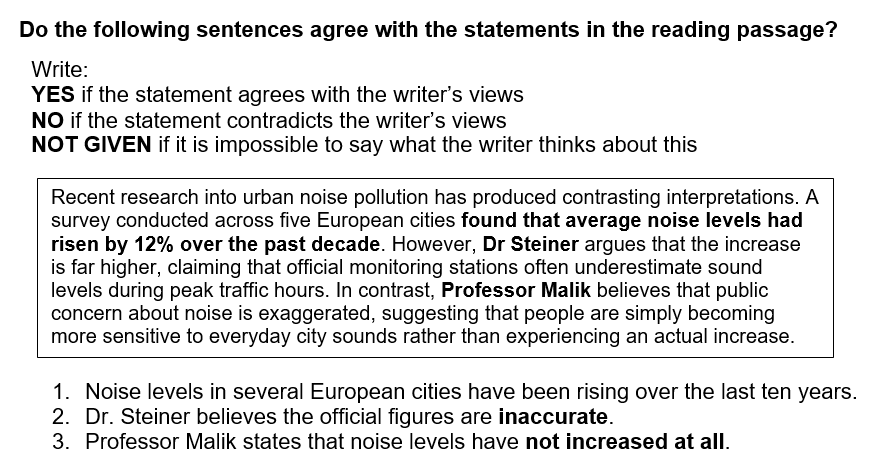
Here is an example of a Yes/No/Not given question that tests the sub-skill 'distinguishing fact from opinion'.
Answers and explanation:
1. YES — The text states as a fact that a survey found noise levels had risen by 12%.
2. YES — Dr Steiner argues (opinion) that the increase is higher and that official stations underestimate levels.
3. NO — Prof Malik doesn’t say noise has not increased; he says concern is exaggerated and people are more sensitive to noise levels (opinion). That contradicts the question statement.
To answer correctly, you must recognise the difference between factual statements and personal opinion.
Insider Knowledge
There is no answer transfer time — unlike Listening, the 60 minutes is all you get.
There are 16 distinct question types, not the 6–8 most prep materials mention.
"False" and "Not Given" are categorically different — False means the passage actively contradicts the statement, Not Given means the passage makes no mention of it.
Qualifying words like "always", "sometimes", "never" change the entire answer — a True claim becomes False if the passage only says "sometimes".
Ready to Test Your Reading Skills?
Complete 1 Reading Test Section with instant scoring. Time needed: ~ 20 min.
Take Diagnostic Test NowNo account required • Get instant results
Personalised Study with Qualified Expert Guidance
Our winning strategy combines the best resources available to get you quickly and efficiently to your Band Score goal.
START NOWFind your Weakness - Develop your Skills - Achieve your Dreams