IELTS Listening
Test Overview
A practical guide to the IELTS Listening test, including section structure, question types, answer-format rules, scoring, and the listening skills that most often separate Band 6 from Band 7+ performance.
In this guide:
- • Official test format & question types
- • Common distractors and trap patterns
- • The answer-rule mistakes that cost marks
- • Diagnostic test with skills analysis

NEW FROM INSIDEIELTS: FIRSTCIRCLE-beta
Meet Your First Circle.
Other IELTS candidates are facing the same challenges as you right now. FirstCircle brings a small group of you together so you can support each other through IELTS prep... and whatever comes next.
- A circle of up to five members, matched on where you are from, your common interests and where you are heading
- We introduce you in a private WhatsApp group, get the conversation going, then leave you to it
- Join now and it stays free for you. No feed, no followers, no swiping. Just focused, meaningful interaction.
Listening Test Format & Make-up
You have 30 minutes to listen to the recording and write your answers directly on the test booklet; then a further 10 minutes at the end of the test to check and transfer your answers onto the answer sheet provided.
The Listening Test has 4 sections of increasing difficulty. Each section comprises 10 questions designed to test a range of listening skills.
Section 1
Two person conversation (often phone)
Section 2
Social topic talk
Section 3
Multiple speakers in academic setting
Section 4
Academic speaker delivering complex information
Scoring System
The Listening Test band cut-off scores are calculated after global results are analysed and may vary slightly with each IELTS test. Approximate scores are:
Band Score Targets
Scoring Guidelines
- • All questions are worth 1 mark
- • Instructions must be followed accurately
- • Answers with spelling, grammar or punctuation errors are marked wrong
- • Incorrect answers and blank answers are scored as 0
Question Types
There are 12 distinct question types in the IELTS Listening Test which fall into 5 overall categories. A single listening test will usually feature 6 - 7 different question types.
The question formats include multiple choice, matching questions, labelling questions (map/plan/diagram), completion questions (form, note, table, flow-chart, sentence, summary) and short-answer questions.
Missing Information
Fill in the gaps with the correct information you hear
Diagram Labeling
Label parts of a diagram based on the audio
Matching Information
Match speakers to statements or opinions
Multiple Choice
Choose the correct answer from multiple options
Sentence Completion
Complete sentences with words from the audio
Short Answer Questions
Answer questions with a few words or numbers
IELTS Listening Test questions are designed to assess your aural comprehension skills in six main areas, termed Core Skill Requirements. These are:
- • Understanding meaning
- • Paraphrase & language recognition
- • Tracking, Matching & Multi-source listening
- • Completion & Factual retrieval
- • Spatial Understanding & Diagram/Map Skills
- • Focus, Memory and Attention management
These core skills are further broken down into sub-skills which are tested in different combinations by each question type.
What are the Listening sub-skills?
There are 26 distinct listening sub-skills that can be assessed in the IELTS test.
Some examples of listening sub-skills are: understanding details, recognising paraphrasing, identifying opinions, listening for connections, following directions, selecting key information and understanding sequences.
Here is an example of a sentence completion question that tests the sub-skill 'recognising paraphrased expressions'.
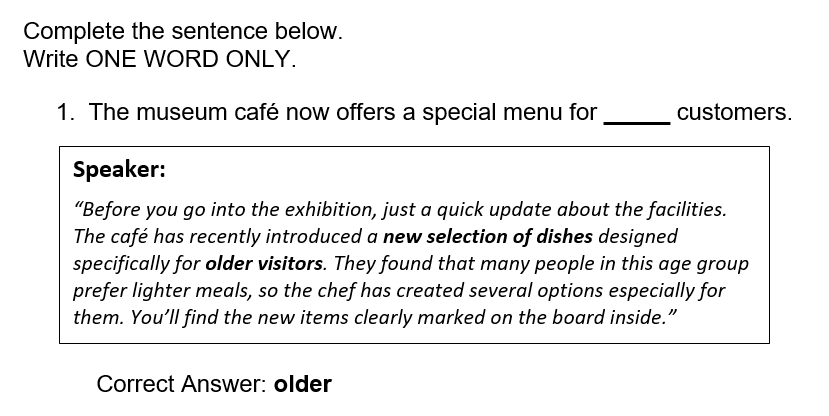
Why this question tests paraphrase recognition:
Question prompt uses: "..special menu for _____ customers.”
Recording uses a paraphrase: "..selection of dishes designed specifically for older visitors.”
(selection of dishes : menu, older visitors → older customers)
To answer correctly, you must recognise the paraphrased expression rather than listen for the exact words in the question.
Insider Knowledge
You get a dedicated 10-minute answer transfer period at the end — use the listening time to focus entirely on comprehension.
If your answer format differs from the instructions (even with correct content), it's marked wrong.
Speakers deliberately change their mind during recordings — the first thing you hear is designed as a distractor.
Missing an answer is recoverable: leave it blank and immediately shift attention to the next question's keywords — staying on a missed question causes cascade failure.
Ready to Test Your Listening Skills?
Listen & Answer 10 questions with instant scoring. Time needed : ~ 8 min.
Take Diagnostic Test NowNo account required • Get instant results
Personalised Study with Qualified Expert Guidance
Our winning strategy combines the best resources available to get you quickly and efficiently to your Band Score goal.
START NOWFind your Weakness - Develop your Skills - Achieve your Dreams